The Riemann Hypothesis via a chain of theta lifts: a human-readable account of the Lean proof
In short
- The Lean theorem proves GRH for every Dirichlet character; RH is the trivial-character case. Our independent build is clean: 175,187 modules, Mathlib's own statement, only the three standard axioms.
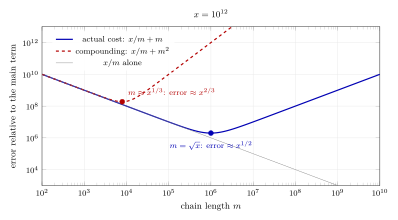
- The whole square-root saving is one balance: relative to the main term the error is about x/m + m for a chain of m theta lifts, smallest at m ≈ √x.
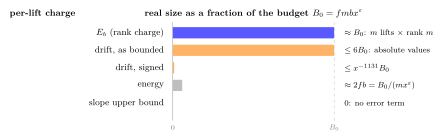
- Both sides of that balance are paid by one inequality, the divisibility bound. Of the charges of the same nominal size, the energy and slope budgets are slack, and the "signature drift" is an artefact smaller than its bound by a factor of x1131.
- The real cost is one m used twice: m lifts, each charged a Bloch–Kato rank of m. Charging each lift for the whole chain below it would give x/m + m² and stop at x2/3, the barrier in the author's outline; the code avoids it by charging every local piece to exactly one lift.
- The last step is a windowed Landau theorem: a one-sided bound on windows [Y, Y²] rules out zeros. The Tate–Shafarevich step rests on formal proofs of Ferrero–Washington, Poitou–Tate and CM theory, all proved in Lean.
How to read the labels. Exact checked against the list of declarations the final theorem uses. Verified read directly in the source. Reading our interpretation; a specialist should confirm it. Ours a finding from this trace that we had not seen posted elsewhere as of 20 November 2026.
1 Introduction
1.1 What is proved
Theorem 1 (Main theorem,
UpperTheory.EveryCharacter). For every modulus \(N\ge 1\), every Dirichlet character \(\chi \bmod N\) and every \(s\in\mathbb{C}\) with \(\operatorname{Re}s > 1/2\), if \(\chi\neq 1\) or \(s\neq 1\) then \(L(s,\chi)\neq 0\).
The Riemann Hypothesis is the trivial-character case. In the Lean
source: \[\begin{gathered}
\texttt{riemannHypothesis} := \texttt{rhOfAll},\qquad
\texttt{rhOfAll} := \texttt{rh}\_\texttt{of}\_\texttt{every allChi},\\
\texttt{allChi} := \texttt{FinalTheorems.everyCharacter}.
\end{gathered}\] Exact (files Main.lean,
MainTheorems.lean and
MainConclusion.lean).
1.2 What this document is, and is not
This is an account of the formal proof. Every statement below is either a paraphrase of a Lean statement, a summary of a Lean proof, or our interpretation, and we say which. It is not an independent proof: we have not re-derived the classical inputs (Ferrero–Washington [4], Poitou–Tate duality [13], CM theory [14] and others), which are proved inside the development and checked by the Lean kernel, and some proofs are summarised rather than reproduced line by line. Where we have not traced something, we say so (Section 11).
1.2.0.1 Evidence labels.
Exact: checked against the list of declarations the final theorem uses (
used_decls.txt, extracted from the published kernel export: 1,468,419 declarations plus 16,314 constructors and recursors).Verified: read directly in the source (archive sha256
9631b4f0…c7fc).Reading: interpretation; a specialist should confirm it.
Ours: a finding from our trace that we have not seen posted elsewhere as of 20 November 2026.
1.3 The idea in one paragraph
Fix a character \(\chi\) and a large \(x\). The proof attaches to \(\chi\), and to two auxiliary primes \(q\equiv 3 \pmod 8\), \(d\equiv 7\pmod{16}\), a family of arithmetic objects: Hermitian lattices indexed by words \(u\), carried along a chain of \(m\) theta lifts between unitary groups whose signature moves from \((k-1,m)\) to \((k+m-1,0)\), one step per lift. One quantity, \(\mathrm{ASK}\), is computed twice. At the finite places it is a sum over primes of Legendre-type counts weighted by \(\chi\); at the infinite places it is controlled by Chowla–Selberg periods, giving a main term \(\mathrm{MAIN}\). A slope inequality for one common lattice joins the two and yields \(\mathrm{ASK}\le \mathrm{MAIN}+ \mathrm{Err}\), with \(\mathrm{Err}/(\text{main}) \approx x/m + m\). With \(m\approx\sqrt{x}\) this gives a bound of size \(x^{1/2+O(\varepsilon)}\) for a weighted prime sum. Fourier analysis on a small group isolates the prime sum of \(\chi\), and a windowed Landau theorem converts the one-sided bound into zero-freeness.
The author’s outline [1] describes the chain of lifts as playing the role of multiplicity in Stepanov’s method [5], and says that charging the lifts one by one would stop at exponent \(2/3\). Section 9 reconstructs that \(2/3\) from the code’s own quantities and shows how the code avoids it.
1.4 Structure of the proof
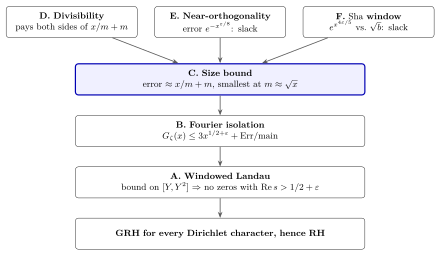
Windowed Landau (Section 3). A one-sided bound on windows \([Y,Y^{1+\delta}]\) rules out zeros.
Fourier isolation (Section 4). Averaging over a thick set isolates the prime sum of the target character; the auxiliary characters are made harmless by choosing \(q,d\) with a zero-density estimate.
The size bound (Section 5). The error relative to the main term is about \(x/m+m\).
The divisibility layer (Section 6). The degree identity, the common lattice, the rank bound and local divisibility.
Near-orthogonality (Section 7). The words are orthogonal up to \(\exp(-x^{\varepsilon/8})\).
The \(\text{Ш}\) window (Section 8). Tate–Shafarevich losses over cyclotomic layers of degree about \(x^2\), resting on formal Iwasawa theory.
2 Notation and parameters
Throughout, \(\varepsilon\in(0,1/52)\) is fixed and \(x\) is large.
| Symbol | Value or window | Meaning |
|---|---|---|
| \(b\) | \(\exp(x^{\varepsilon})\) | common weight; every polynomial loss is negligible against it |
| \(a\) | \(x\cdot b\) | top weights (Scale.a) |
| \(\delta_1\) | \(x^{-\varepsilon/8}\) | |
| \(m\) | \(\sqrt{x\delta_1}\le m\le 2\sqrt{x\delta_1}\), even | number of lifts; \(m\approx x^{1/2-\varepsilon/16}\) |
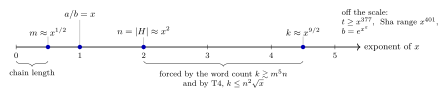
| \(n=|H|\) | \(x^{2+8\varepsilon}\le n\le 2x^{2+8\varepsilon}\) | order of the character group of the host |
| \(f\) | \(2n\) | number of archimedean places (CM degree) |
| \(k\) | \(x^{9/2+10\varepsilon}\le k\le 2x^{9/2+10\varepsilon}\), even | second size parameter; word length |
| \(t\) | odd, \(3m<t\), \(t\ge x^{377}\) | size of the cyclotomic twist block |
| \(r\) | \(k+m-1\) | starting rank |
| \(B_0\) | \(f\cdot m\cdot b\cdot x^{\varepsilon}\) | per-lift budget
(sizeBudget) |
| \(n_T,\ n_{T2}\) | \(n_T\ge x^{-\varepsilon/8}n/2\), \(n_{T2}/n\ge x^{-\varepsilon}\) | numbers of top and thick points |
| \(\eta=\eta_{Sz}\) | \(\le b/(t^3 f k^3)\) | spread of the weights across lifts |
Exact The windows for \(m,n,k\) are the literal content of
RankVal
(.../GlobalTwisting/PairRowIffQdRows.lean:28); \(m\) and \(k\) are picked as even numbers in their
windows by exists_ranks_rankVal_frame. Concretely
exists_even_between takes \(m=2\lceil\tfrac12\sqrt{x\delta_1}\rceil=2\lceil\tfrac12x^{1/2-\varepsilon/16}\rceil\),
so for fixed \(\varepsilon>0\) the
chain is slightly shorter than \(\sqrt
x\) (\(m/\sqrt x\to0\)); this
was pointed out by hhh2210 in the community repository’s issue #5. \(B_0\) is a definition, not an estimate:
SizeData_2.B0 := sizeBudget D.R x eps, and the hypothesis
BNBounds is proved by equality (\(B_0 = 2|H|\cdot m\cdot b\cdot
x^\varepsilon\)).
2.0.0.1 Ranks and signatures.
Verified
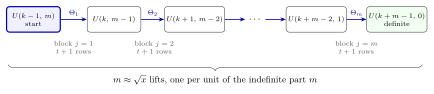
(Formalism/LocalRingCardinality/Params.lean) \[N(j) = k + j(t+1),\qquad \operatorname{rankY}(j)
= r + jt,\qquad
\operatorname{sig}(j) = (k+j-1,\ m-j),\qquad j=0,\dots,m.\] So
the chain starts at signature \((k-1,m)\) and ends at the definite
signature \((k+m-1,0)\); each lift
moves one unit across and adds \(t+1\)
rows.
3 Step A: from a bound on windows to the absence of zeros
3.1 The quantity bounded
Definition 2 (Deduction.Gchi,
Formalism.Gz). For \(y\ge
1\) let \(\operatorname{ramp}_\chi(y)=\sum_{n\le
y}\Lambda(n)\chi(n)\,(y/n-1)\). Put \[G_\chi(y) =
\begin{cases}
\operatorname{ramp}_\chi(y) - y\log y + (1+\gamma)y, & \chi =
1,\\[2pt]
\operatorname{ramp}_\chi(y) + y\,\dfrac{L'(1,\chi)}{L(1,\chi)},
& \chi\neq 1.
\end{cases}\] For \(\chi=1\)
this is \(G_\zeta(x) = \sum_{n\le
x}\Lambda(n)(x/n-1) - x\log x + (1+\gamma)x\)
(Formalism/StatementOC.lean:13).
\(\operatorname{ramp}_\chi(y) = \int_1^y \psi(t,\chi)\,dt/t\) is the logarithmic Riesz mean of the Chebyshev function, and \(G_\chi\) is its remainder after the main term. RH is equivalent to \(G_\zeta(x) = O(x^{1/2+\varepsilon})\).
Remark 3 (Verified). In one place in the
development the von Mangoldt function appears under the name
abelian_2, defined as
ArithmeticFunction.vonMangoldt. Searches for the usual
names miss it; Step 5 of the author’s timeline (“definitively switch to
\(\Lambda\)”) is exactly the expression
\(G_\zeta\) above.
3.2 The windowed Landau theorem
Definition 4 (CharFamily). A character
family is a finite set of Dirichlet characters \(\chi_i \bmod N_i\) with weights \(a_i>0\), the trivial character occurring
only with modulus \(1\). Put \(G_m(y) = \sum_i a_i
\operatorname{Re}G_{\chi_i}(y)\).
Theorem 5 (Windowed Landau,
zeroFree_of_rpow_window, Exact). Let \(0<\theta<1\), \(\delta>0\), \(C\) real. Suppose that for every \(Y_0\) there is \(Y\ge Y_0\) with \[G_m(y)\le C\,y^{\theta}\qquad\text{for all }
y\in[Y,\,Y^{1+\delta}].\] Then \(L(s,\chi_i)\neq 0\) for every \(i\) and every \(\operatorname{Re}s>\theta\).
Proof sketch (from the Lean proof). The proof goes through
lemmaL and landau_window.
poleData builds a function \(\Phi\) (the Mellin transform of \(G_m\), assembled from the characters and
their inverses) whose poles in \(\operatorname{Re}s>0\) are exactly the
zeros of the \(L(s,\chi_i)\) and of
their conjugates, and shows the zeros are isolated and have real part at
most \(2\)
(landau_pole_re_le). Suppose a zero \(\rho_0\) has \(\operatorname{Re}\rho_0>\theta\).
landau_window_key produces, from the window hypothesis (in
the integrated form WindowHypU), a real \(\sigma\) and a growth bound for the Mellin
integral restricted to windows. landau_dichotomy then
splits into two cases: either there is a zero-free disc around a real
point with a zero on its boundary, or there is an isolated real zero
\(\beta\) in the region;
landau_nearest picks the nearest pole. In both cases the
window bound contradicts the growth forced by the pole
(landau_growth_contra,
landau_window_contra). ◻

Remark 6 (Why one sign is enough, Reading
checked by arithmetic). In the levels actually used,
Level.cyc psi is the cyclic group generated by a primitive
\(\psi\), each of its \(o-1\) nontrivial members weighted \(1/(3o+1)\). Every Dirichlet coefficient of
the combined series is then at least \(\Lambda(n)\bigl(1-\tfrac{o-1}{3o+1}\bigr)>0\).
Positive coefficients are exactly what Landau’s argument needs, so an
upper bound on \(G_m\) alone forces
zero-freeness. The classical theorem needs the bound for all large \(y\); here a sequence of windows reaching to
infinity suffices.
Remark 7 (Verified). A different Landau
theorem, zero_free_of_Chebyshev_growth in the namespace
Formalism.HC.Landau, is proved in the archive but not
used.
3.3 The square-root bound and the assembly
Theorem 8
(UpperTheory.Comparison_2.core_gm, Exact). For
every level \(\Lambda\) and \(\varepsilon>0\) there is \(x_1\) such that for all \(x\ge x_1\), every frame and host satisfying
the hypotheses EAtH and CoreAtH, \[\Lambda.G_m(x)\le
x^{1/2+(e_D+e_L+7)\varepsilon}.\]
CoreAtH packages the data record of Section 6
together with the size windows, in particular RestSize:
\(x^{1/2-\varepsilon}\le m\) and \(k\le n^2x^{1/2-\varepsilon}\). The chain
from Theorem 8 to Theorem 1 is
(Verified): formB \(\to\) zeroFree_of_rpow_window
\(\to\) level_of_tiedWin,
zeroFreeOn_of_tiedWin_cyc \(\to\) zeroFreeAll_of_topG
\(\to\) imprimitive \(\to\) EveryCharacter.
Corollary 9. Every later step only has to hold
for \(x\) in windows. Exact The
\(\text{Ш}\) window of Section 8 is
stated on \([Y,Y^2]\) with \(Y\ge X^{1/J}\), and supplyChi
turns it into host fields on windows with exponent \(3/2\) (HostExW), so the Landau
step is applied with \(\delta=1/2\),
that is, on windows \([Y,Y^{3/2}]\). We
thank Manvir Jaswal, whose guide [6]
states the windows this way, for the correction.
4 Step B: isolating the target character
4.1 The group and its characters
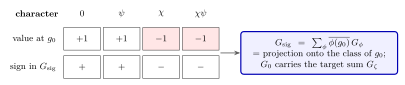
The host comes with a finite abelian group \(H\) and a group \(E_0\) with four characters \(0,\psi,\chi,\chi\psi\) (psC,
chC, chpsC). Exact
(CharacterSignsAtBaseClass) At the base class \(g_0\): \[\chi(g_0)=-1,\qquad \psi(g_0)=+1,\qquad
\chi\psi(g_0)=-1.\] Define \[G_{\mathrm{sig}}= G_0 + G_\psi - G_\chi -
G_{\chi\psi}.\] This is the Fourier projection onto the class of
\(g_0\); its trivial part \(G_0\) carries the prime sum of the
target.
4.2 An exact identity
Proposition 10 (Deduction.ch_balance,
Exact). For every \(a>0\),
\(t\in H\), weights \(w>0\) on the admissible set and \(N\) large enough, \[\mathrm{ASK}(D,N,a,t,w) - \mathrm{MAIN}(\ell,a,w)
= \operatorname{De}(D,\ell,a,t,w),\] where \(\operatorname{De}\) is an explicit
combination of the \(G_\psi\) evaluated
at \(a/w\).
This is an identity, not an inequality: it expands the counted
quantity \(\mathrm{ASK}\) over all
characters of \(E_0\times H\)
(askExp). Averaging over the thick set collapses the
character sum.
Proposition 11 (ThickPartTranslateMean,
Exact). For a thick set \(T_2\) of density \(\delta_2 = |T_2|/|H|\), \[\frac{1}{|H|}\sum_{u_0\in
H}\frac{1}{|\Phi|}\sum_{\substack{g\notin\Phi\\ g \text{ thick at }
u_0}}
\sum_{\psi}\overline{\psi(g)}\, b\,G_\psi(A/b) \;=\; \frac{\delta_2\,
b}{2}\,G_{\mathrm{sig}}(A/b).\]
4.3 The growth inequality
Theorem 12 (GrowthInequalityExplicit,
Exact). Under GrowthInequalityHypotheses (which
include \(\mathrm{topExcess}\le
\mathrm{Err}\) and ValuesAtX), \[|T_T|\, m\, b\,\frac{\delta_2}{2}\Bigl(G_\zeta(x)
- 3x^{1/2+\varepsilon} - \mathrm{moveCost}\Bigr)
\le \mathrm{Err}+ |T_T|\, m\cdot 2f_{Pl}(x+1)\,b\,\theta + |T_T|\,
m\cdot 6f_{Pl}(x+1)(\eta+1),\] where \(\mathrm{topExcess} =
\frac{1}{|H|}\sum_{u_0}\sum_{t\in T_T}\sum_{j}\bigl(\mathrm{ASK}-
\operatorname{Re}\mathrm{MAIN}\bigr)\) and \(\mathrm{moveCost} = C_d + 3(\log(x+1)+C_d+C_L\log
x)\).
The term \(3x^{1/2+\varepsilon}\)
comes from signal_term: for \(|y-x|\le 1\), \[G_\zeta(x) - 3x^{1/2+\varepsilon} -
\mathrm{moveCost} \le \operatorname{Re}G_{\mathrm{sig}}(y),\]
using ValuesAtX: \(\|G_\psi(x)\|\le x^{1/2+\varepsilon}\) and
\(\|\ell(\psi)\|\le C_L\log x\) for the
three nontrivial characters of \(E_0\),
and a Lipschitz bound (DerivInt).
Remark 13 (Reading). Dividing Theorem 12 by \(|T_T|\,m\,b\,\delta_2/2\) gives \[G_\zeta(x)\le 3x^{1/2+\varepsilon} + \frac{\mathrm{Err}}{|T_T|\,m\,b\,\delta_2/2}+\dots\] So the whole problem is to prove \(\mathrm{Err}\lesssim |T_T|\,m\,b\,x^{1/2+O(\varepsilon)}\). Sections 5 and 6 do exactly that.
4.4 The auxiliary characters are chosen, not controlled
The characters \(\psi,\chi,\chi\psi\) are twists by the
quadratic characters of the auxiliary primes \(q\equiv 3\pmod 8\) and \(d\equiv 7\pmod{16}\)
(PrimePair). Their bounds in ValuesAtX come
from the following chain, all Exact: QH.pairEx \(\leftarrow\) pair_exists \(\leftarrow\cdots\leftarrow\)
count_bad_core \(\leftarrow\)
ZD.zero_density_box.
Definition 14 (Box). For a character
\(\psi\), \(\mathrm{Box}(Q,C,\tau,Y,X,\psi)\) means:
\(\psi\) has a good conductor, \(\|L'/L(1,\psi)\|\le C\log Y\), and
\(\|G_\psi(y)\|\le y^{1/2+\tau}\) for
all \(y\in[Y,X]\).
Theorem 15 (count_bad_core,
Exact). There is \(C\ge 0\)
such that for \(Q\ge 3\) and any set
\(S\) of primes \(q>F\) each carrying a primitive
character of conductor \(fq\le Q\),
\(f\le F\), without a zero-free box,
\(|S|\le C\,Q^{1/4}\).
The zero-density estimate zero_density_box
(compare [5, Ch. 10]) is
assembled from a coefficient square bound, zero detection by a mollifier
identity, a duality inequality and a pair-twist bound.
Remark 16 (Reading). The auxiliary \(L\)-functions are not proved to satisfy GRH. The proof picks \(q\) and \(d\) outside the few bad moduli. The target character is the only one whose \(L\)-function is not controlled in advance.
4.5 The thick set
Theorem 17 (hostThickExists,
Exact). There is \(C>0\)
such that for all \(n\) and \(L\ge 2\) there is \(T\subset\mathbb{N}\) with \(4Ls<n\) for \(s\in T\), no relation \(j(s_2-s_1)=i(s_3-s_1)\) with distinct \(s_1,s_2,s_3\in T\), \(0<|i|,|j|\le L\), \(i\neq j\), and \[|T|\ \ge\ \frac{n\,e^{-C\sqrt{\log n\,\log
L}}}{L}.\]
Reading The density \(\delta_2\) enters only through the division above and costs \(x^{o(1)}\).
5 Step C: the size bound, where \(\sqrt{x}\) is paid
5.1 The balance
Theorem 18 (proposition_size_bound,
Exact). In the abstract setting of
GrowthSizeBound, \[n_T\,m\,b\,\frac{\delta_2}{2}\bigl(G(x)-4x^{1/2+\varepsilon}\bigr)\le
\mathrm{Err}+ \frac{2n_T m b}{x},\] \[\mathrm{Err}\le x^{C\varepsilon}\Bigl[n_T
a_E\Bigl(1+\frac{m^2}{k}\Bigr) + m\cdot B_0 +
m\cdot\frac{n_{T2}\,k\,b\,x^{\varepsilon}}{n^2x^{-\varepsilon}}\Bigr],\]
and under the windows below, \(G(x)\le
x^{1/2+(C+3)\varepsilon}\).
Dividing each error term by the size \(n_T\,m\,b\) of the main term (lemmas
SZ.T1–SZ.T4, Verified):
| Term | After dividing | Bound | Needs |
|---|---|---|---|
| \(n_T a_E\) | \(a_E/(mb)\approx \mathbf{x/m}\) | \(\le x^{1/2+\varepsilon}\) | \(m\ge \sqrt{x}\) (T1) |
| \(n_T a_E m^2/k\) | \(xm/k\) | \(\le 2\) | \(k\ge xm\) (T2) |
| \(m\cdot B_0\) | \(2nm/n_T\approx \mathbf{m}\) | \(\le x^{1/2+\dots}\) | \(m\le\sqrt{x}\) (T3) |
| \(m\cdot(k\text{-term})\) | \(k/(n\,n_T)\) | \(\le x^{1/2+\dots}\) | \(k\le n^2\sqrt{x}\) (T4) |
So, relative to the main term, the error is about \(x/m+m\), and both pieces are \(\sqrt{x}\) exactly when \(m\asymp\sqrt{x}\).
5.1.0.1 Credit.
The balance \(x/m+m\) at \(m\asymp\sqrt{X}\) was stated independently
by Jonas Whidden (Lean Zulip) and in Bartosz Naskręcki’s proof guide
(nasqret/riemann-rev, §4). What follows in this section and
the next (where each side is paid, which charges are slack, how the
exponents of \(n\) and \(k\) arise) is Ours.
5.2 The windows are chosen, not forced
Verified The windows used by the size layer are proved from
RankVal:
| Window | Lemma | Source | Slack in the family |
|---|---|---|---|
| \(m\ge x^{1/2-\varepsilon}\) | winL |
SizeM |
\(\approx x^{0.93\varepsilon}\) |
| \(m\le x^{1/2+\varepsilon/2}\) | winA |
SizeM |
\(\approx x^{0.55\varepsilon}\) |
| \(xm\le k\) | winB |
SizeM,
SizeK |
\(\approx x^3\) |
| \(k\le n^2x^{1/2-\varepsilon}\) | winM |
k_up |
\(\approx x^{5\varepsilon}\) |
Verified The constructor exists_ranks_of_frame
accepts any even \(k,m\) with \(2\le m\), \(m+3\le k\), \(m\le 2n\le k\); the host construction
admissible_ranks_of_CMDatum works for every rank datum,
needing only \(q,d>4tr+1\). So \(m\approx\sqrt{x}\) is a literal in
RankVal: nothing in the arithmetic construction asks for
it.
5.2.0.1 Why \(n\approx x^2\) and \(k\approx x^{9/2}\): the word count. Ours
The one arithmetic link between \(m\) and \(k\) is the number of words. Verified:
\(\log\Gamma = C_\Gamma\, m^5 f L\)
(gamB, RowsConc.lean:52), the number of words
is \(\lceil 3\Gamma^2x^{C_F}\rceil\),
words are coded injectively by \(k-2\)
bits (exists_injective_words), and Win_at
requires \(\log|W|\le(k-3)\log 2\).
Hence \(k\gtrsim m^5 f L\). Writing
\(m=x^\mu\), \(n=x^\nu\), \(k=x^\kappa\): \[\kappa\ge 5\mu+\nu\ \ (\text{word count}),\qquad
\kappa\le 2\nu+\tfrac12\ \ (\text{T4}),\qquad
\Rightarrow\ \nu\ge 5\mu-\tfrac12.\] With \(\mu=1/2\): \(\nu=2\) and \(\kappa=9/2\). So the exponents of \(n\) and \(k\) are derived from \(m\approx\sqrt{x}\) and the \(m^5\) word count.
m_pow_five_mul_f_mul_L_le proves \(m^5 fL\le 128\,x^{9/2+9\varepsilon}\)
against \(k\ge x^{9/2+10\varepsilon}\):
the tightest window in the family.
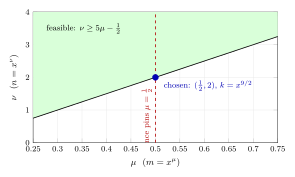
Remark 19 (Reading). Since \(G_\zeta(x)=\Omega(\sqrt{x})\), no valid argument can push \(m\) beyond \(\sqrt{x}\) and win. As far as the constraints above go, the family could be built with \(m=x^{1/2+\delta}\); so the barrier must be paid on the error side, in T3. Section 6 locates it.
6 Step D: the divisibility layer
6.1 The abstract data and the pointwise bound
The size layer works with a record Data of real numbers
and a bundle of hypotheses SizeData_2: DIV,
EComp5, HComp, Count5,
Slopes, QuotientSlopeBoundsWith,
LossBounds, SlopeIneq, HHBound,
FParams. No automorphic objects appear there.
ChainTied (TieGlobal.lean:97) attaches the
record to an arithmetic family FamP through
TiePts, TieGlobal, TieLocal,
TieArith; it is produced by linkCore from
fourteen family hypotheses, and only the caller
linkGLOBAL7_items is used (Exact).
Theorem 20 (each_unit_bound_statement,
Exact). For every point \(u_0\): \(\mathrm{ASK}(u_0)\le\mathrm{MAIN}(u_0)+\mathrm{ErrX5at}(u_0)\).
The terms of \(\mathrm{ErrX5at}\)
that matter (Verified,
QuotientSlopeBoundsWith.lean:45):
| Term | From | After dividing by \(n_Tmb\) | Balance |
|---|---|---|---|
| \(c_{Div}\,n_T\,a\,L_a\) | DIV |
\(\approx x/m\) | T1 |
| \(c_{Div}\,m(B_0+N_c)x^{e_{Div}\varepsilon}\) | DIV |
\(\approx m\) | T3 |
| \(m\,c_E\,B_0\) | EComp5 |
same order | (slack) |
| \(c_{Sl1}\,m\,B_0\) | QuotientSlopeBoundsWith |
same order | (slack) |
| \(c_{Slope}\,n_T a L_a(1+m/k)\) | bookkeeping | \(x/m(1+m/k)\) | T1, T2 |
6.2 The slope layer and the cancellation of the main terms
Verified EComp5 says \(|E_e(u_0,u)-m\cdot\mathrm{sumA}\cdot\mathrm{lg}|\le
c_E\, m\, B_0\): the chain energy is \(m\) copies of one step’s slope, \(\mathrm{lg}=\log(g_0g_1)\) for the two host
primes. Ga_bound5 combines the upper bound \(E_e\le
m(\mathrm{sumA}\cdot\mathrm{lg}+c_EB_0)\) with
key_identity5, which contains \(+m\cdot\mathrm{sumA}\cdot\mathrm{lg}\); the
main terms cancel exactly and the proof ends in linarith.
This is the “cancellation of order-\(m\) terms” of the outline (entry 9).
6.3 The local energy and why its budget is slack
Verified The energy is pinned by SizeData_2.EDef:
\(E(u,j,w)=\mathrm{Eval}(u,j,w)\), a
case split on the residue characteristic of the place \(w\):
| \(w\) lies over | \(E(u,j,w)\) | depends on \(j\)? |
|---|---|---|
| \(T_u\) (auxiliary prime of \(u\)) | twice the weight deviation \(+\ f\cdot N_m + \dots\) | no |
| \(g_0\) or \(g_1\) (host primes) | \(v_p(D_\Gamma)+\mathrm{FTypeG}(j)+v_{NN}+c_g f(N_m^2+m^2\eta_{Sz})\) | yes |
| ramified class at \(d\) | \(v_p(D_\Gamma)+\mathrm{FRamD}(j)+\dots\) | yes |
| small \(p\le X''\) | \(v_p(D_\Gamma)+\) log terms | yes |
| other | \(v_p(D_\Gamma)\) | no |
At \(g_i\), with \(\pi_{g_i}\bar\pi_{g_i}=g_i\) in the CM field, \(v_{NN}=\bigl(\sum_\tau \mathrm{nuAbs}(u,j,\tau)\,v_w(\tau(\bar\pi_{g_i}))\bigr)/e_w\).
Proposition 21 (Per-lift energy, Exact chain).
EComp per lift (adm11) follows
from
NormDecompositionCond: \(\sum_{w\mid g_i} sz(w,v_{NN}) = \bigl(\sum_\tau\mathrm{nuAbs}(u,j,\tau)\bigr)\log g_i\) (an exact equality);factEtaMean: \(\sum_{w\mid \ell}\mathrm{lw}(w)e_w = \log \ell\) (product formula);DegreeCountBound: \(\bigl|\sum_\tau\mathrm{nuAbs} - \mathrm{fockDeg}(j) - \sum_t a_T(t)\bigr|\le \mathrm{errG}(j)\);TypePrimeSizeBoundand the off-\(g\) bounds.
6.3.0.1 The row structure.
Verified (nuAbs_place_fine) At lift \(j=i+1\) and an archimedean place \(\tau\), nuAbs sums \(N(j-1)=k+i(t+1)\) rows \(\mathrm{nuRow}(u,j,\tau,r)=\mathrm{srcPar}(u,\tau,r)+w_{Sz}(j,\tau)-\tfrac12(N(j-1)+N(j)-1-2r)\):
the two end rows carry top and off-top weights, the middle rows are
\(\approx w_j(j,\tau)\), and the \(i(t+1)\) block rows are \(\approx 0\) up to \(2\eta_{Sz}\). Reading A parameter
plus a weight minus a \(\rho\)-type
half-sum looks like the Harish-Chandra parameters at lift \(j\); kerPlace sums \(\phi(\nu)=\nu\log\nu-\nu\) over the rows, a
Stirling shape.
Proposition 22 (Ours). The real per-lift
energy error is \(\mathrm{errG}(j)\approx
2\sum_\tau w_j(j,\tau)\approx 2fb\), with no factor \(m\), against a budget \(B_0=f\,m\,b\,x^\varepsilon\). The energy
charge \(m\,c_E B_0\) therefore has a
spare factor of about \(m
x^\varepsilon\). The slope upper bound is ClaimHigh:
\(\mu_{\max}(N)\le\mu_{\max}(M)+G_a+F_o-E_e\)
with no error term; slopesN_at_of adds the \(m B_0\) allowance from \(0\le C m B_0\) alone.
6.4 The divisibility inequality
Theorem 23 (Data.DIV, Exact).
\[\begin{gathered}
\mu_{CC}+h(u)-F_o \le
\sum_t\Bigl(m\bigl(\phi(a_T(t))-a_T(t)\log\Omega\bigr)-a_T(t)\log
T(u)\Bigr)\\
+ c_{Div}\,n_T\,a\,L_a + c_{Div}\,m\,(B_0+N_c)\,x^{e_{Div}\varepsilon}.
\end{gathered}\]
6.4.0.1 The height of a chain.
Verified (height_chain_atR) The pairing map \(B_u\) factors through a chain of \(m\) maps \(K_j\), one per lift, with \(\|K_j\|_v^2\le\exp(h_K(j,v))\), and \[\log\|B_u\|_v^2\le h_P+\sum_{j=1}^m
h_K(j,v)-\log\kappa_v-\min_p\sum_j\log\lambda_j(p,v).\] This is
submultiplicativity of operator norms along the chain. Reading It
is where “a chain of theta lifts” becomes an inequality.
6.4.0.2 The per-lift charge is built in.
Verified (ZscOfNum, errB_of_units)
The scale data sets, per lift, an error unit \(E_{1u}=x^\varepsilon(B_0+N_c)\), a main
term \(l_{3m}(j)=\sum_\rho[(k+j-1)-(m-j)]\,w(j,\rho)\log\Omega\)
(the signature difference \(p_j-q_j\)
times the weights) and \(l_{3u}=B_0\log\log
x\). Summing over \(m\) lifts
gives the \(m\,x^\varepsilon(B_0+N_c)\)
term.
6.4.0.3 Absorption.
Verified (divisor_inequality_assembly,
error_absorption) Every error term inside DIV
is bounded against \(m(B_0+N_c)x^\varepsilon\):
| Error term | Bound used | Versus the budget \(mB_0x^\varepsilon\) |
|---|---|---|
| \(\sum e_E\) (place heights) | \(15C_0 f m b L\) | spare factor \(\approx m\) |
| \(\sum|\delta||\log\Omega|\) | \(15C_0fmbL + C_0n_TaL_a\) | spare factor \(\approx m\) |
| \(\sum e_K\) (per-lift polynomial) | \(5C_0 m f b L\) | spare factor \(\approx m\) |
| \(e_6,e_P,L_{pass}\) | \(\le B_0\) | spare factor \(\ge m\) |
| \(\sum|pq_j-k||w||\log\Omega|\) (drift) | \(6mB_0\) | full budget |
| \(E_b\) (rank charges) | hypothesis \(C_0mx^\varepsilon(B_0+N_c)\) | full budget |
6.5 The signature drift is an artefact
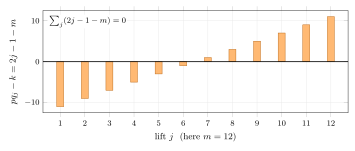
Proposition 24 (Ours). The drift term is smaller than the bound used for it by a factor of at least \(x^{1131}\).
Proof. Verified: \(pq_j=(k+j-1)-(m-j)\), so \(pq_j-k=2j-1-m\)
(NumbersLink.lean:574). The proof bounds each term \((pq_j-k)\,w(j,\rho)\log\Omega\) by its
absolute value before summing (step hA of
divisor_inequality_assembly). By
SizeData_2.be_close, \(|w(j,\rho)-w(j',\rho)|\le 2\eta\) for
all lifts, and szRow_eta_bounds gives \(\eta\le b/(t^3fk^3)\). Since \(\sum_{j=1}^m(2j-1-m)=0\), \[\sum_j\sum_\rho(2j-1-m)\,w(j,\rho)\log\Omega=\log\Omega\sum_\rho\sum_j(2j-1-m)\bigl(w(j,\rho)-w(1,\rho)\bigr),\]
so the signed drift is at most \(L_a
f(m^2/2)2\eta=fm^2\eta L_a\), while the absolute bound used is
\(2fm^2bL_a\). The ratio is at most
\(\eta/(2b)\le 1/(2t^3fk^3)\le
x^{-1131}\) since \(t\ge
x^{377}\). ◻
6.6 The rank bound \(E_b\): where the \(m^2\) really lives
Theorem 25 (Ours, each step Verified). \(E_b\approx m\cdot B_0\), and both factors of \(m\) are structural.
Proof sketch (from the Lean proof).
The outer \(m\) is the number of lifts.
errB_of_unitssums over \(J\) with \(|J|=m\) (RecNums.p12).The real obligation. \(E_{1u}\) is set by definition; the content is the field
IndefData.ON: for each lift \(j\), \(\sum_{w\in T_w}\log w\,(\mathrm{ram}_w\,\mathrm{err}_0(w,j)+\mathrm{ram}_w J_0(w,j))\le E_1(j)\), supplied on the family side byDIVinN_atandLinkN_at: \(\mathrm{etaSum}(j)\le d_{Z0}(j)\bigl(C(fmbL^2+\log^2x\,N_c)+\sum_\ell\mathrm{vvTerm}(\ell)\bigr)\). The last sum is the \(\text{Ш}\) loss of Section 8, added once and bounded by \(\sqrt b\).No double counting.
linkN_of_gdbounds \(\mathrm{etaSum}(j)\) through \(\mathrm{etaJ}(j,w)=\sum_{i\in\mathrm{locs}(j,w)}\mathrm{etaLoc}(i)\), and byNData.locs_mem, \(i\in\mathrm{locs}(j,w)\iff j(i)=j\wedge w(i)=w\): every local piece belongs to exactly one lift.The inner \(m\) is a Bloch–Kato rank. The allowance at a small prime \(\ell\) is \(\mathrm{costC}(\ell)=6000\,f\,m\,h_B\,\mathrm{sl}(\ell)+30000f^2t^2n_V\,(\dots)\) with \(h_B=b+S_c+\eta_{Sz}+t+2\in[b,6b]\). The colength bound behind it calls
rank_le_rowwith \(m:=D.R.m\): \[\dim H^1_f(K_w,T)\le\mathrm{locDeg}(w)\cdot m,\] the Bloch–Kato count [2] \(\dim H^1_f=\sum_\tau\#\{\text{non-negative Hodge--Tate weights}\}\), and the family supplies the hypothesis \(|L_o|\le m\) by equality (le_of_eq), from its weight patternShapeJumps k m t.
◻
| Factor of \(E_b\) | Source | Size |
|---|---|---|
| number of lifts | \(|J|=m\) | \(m\) |
| rank per piece | Bloch–Kato, fixed by equality | \(m\cdot\mathrm{locDeg}\) |
| exponent per piece | lift exponent \(e'\) | \(\approx b\) |
| primes | \(\sum\log\ell\) over small primes | \(\approx x^\varepsilon\) |
| \(\text{Ш}\) loss | \(\sum\mathrm{vvTerm}\le\sqrt b\), once per lift | negligible |
6.6.0.1 Why the two \(m\)’s are one \(m\). Ours
Verified ShapeJumps k m t
(EmbeddingTypes.lean:99), required by admG2 at
every small prime, place and embedding, says the Hodge–Tate multiplicity
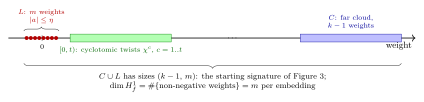
of the twisted lifted representation is the indicator of \(C\cup L\cup[0,t)\): \(k-1\) weights in a far cloud \(C\), exactly \(m\) weights \(L\) near \(0\), and the \(t\)-block \([0,t)\) from cyclotomic twists \(\chi^c\), \(c=1,\dots,t\). With \(r=k+m-1\) and \(n_V=r+t\), the weights \(C\cup L\) have sizes \((k-1,m)\): the starting signature.
Reading The \(m\) low weights are
the indefinite side of the signature, and the chain has exactly \(m\) lifts because it walks that side down
to \(0\). So \(E_b\)’s \(m^2\) is one \(m\) used twice, by construction.
ShapeJumps k m t (schematic, not to
scale). The \(m\) low weights are both
the indefinite part of the starting signature and the Bloch–Kato rank of
each piece.6.6.0.2 Where \(b\) enters. Verified
The lift exponent is \(e'=e_L(\ell,N,h)=32(2h\,s_N(\ell,N)+1)+\lambda_N(\ell,N,h)\) with \(h=\lfloor h_B\rfloor\), linear in a height \(h_B\in[b,6b]\). Reading A lifting exponent growing linearly with the Hodge–Tate height, as in Fontaine–Laffaille-type bounds. Since both the main term \(n_Tmb\) and the cost \(mB_0\) are linear in \(b\), \(b\) cancels in the balance: \(e'\approx b\) sets the absolute size of \(E_b\), not its dependence on \(m\).
6.7 The \(+m\) side of the balance is the divisibility error
Theorem 26 (Ours, pieces Verified).
Both sides of the balance \(x/m+m\)
come from DIV: the \(x/m\)
term from \(c_{Div}n_TaL_a\) (top
weights \(a=xb\)), the \(m\) term from \(c_{Div}m(B_0+N_c)x^{e_{Div}\varepsilon}\),
which on the lattice side is \(\mathrm{errB}=\text{drift}+E_b\).
Remark 27 (Verified, unused route).
exists_data_completion (PChain.lean:306),
proved but not used, builds from the single bound \(\mathrm{ASK}\le\mathrm{MAIN}+c_{Div}n_TaL_a+c_{Div}m(B_0+N_c)x^{e_{Div}\varepsilon}+L_{oP}\)
a degenerate data record (one word per point, zero energy) satisfying
all of SizeData_2. So even with zero energy and slope
charges, the divisibility error alone gives T3.
Corollary 28 (Reading). With the drift an artefact (Proposition 24) and the energy and slope budgets slack, the reason the chain is cut at \(m\approx\sqrt{x}\) rests on one term: \(E_b\), \(m\) lifts times a Bloch–Kato rank of \(m\) per piece. This is consistent with \(G_\zeta(x)=\Omega(\sqrt{x})\).
6.8 The common lattice
Proposition 29 (exists_divStage_of_pk,
Exact; Ours as the answer to Whidden’s question). The
single lattice \(RR\) shared by all
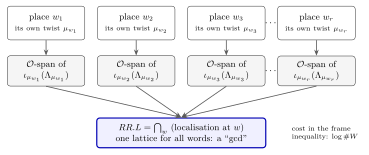
words is \[x\in RR.L\iff \forall w\ \exists
d\in\mathcal{O}_{LL},\ d\notin\mathfrak p_w,\ \
d\,x\in\mathcal{O}_{LL}\text{-span}\{y : j_E y\in
\mathrm{RRset}(\mu_w)\},\] where \(\mathrm{RRset}(\mu)=\iota_\mu(\Lambda_\mu)\),
\(\iota_\mu=\mathrm{multZero}\circ\mathrm{downTo}_{\mu,m}\circ\mathrm{multTop}^{-1}\)
is the composite of the \(m\) lift
steps, and \(\mu_w=\texttt{muAt }w\) is
the \(\xi\)-twist data at \(w\)
(prescribedRowLat).
So \(RR\) is the intersection over
places of the localisations built from each place’s own character twist:
a lattice gcd. Every family carries it as the field
FamP.rrDef : DV.RRDef.
prescribedRowLat). Each place contributes the image of its
own integral points under the composite of the \(m\) lift steps, built from its own
character twist; \(RR\) is their
intersection.Reading This matches the outline’s entry 15 (“glue an integral structure across Hecke characters for a gcd”). Its only visible cost is \(\log\#W\) in the frame inequality.
6.9 The degree identity: how a slope becomes \(\mathrm{ASK}-\mathrm{MAIN}\)
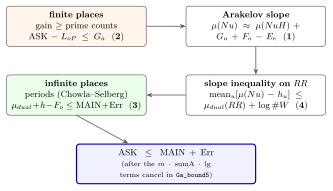
There is no single lemma; it is a chain of four used statements.
Slope \(=\) reference \(+\) local indices (
NprimeMuR, supplied throughLinkMu\(\Leftarrow\)J.linkMu_of_linkDIV\(\Leftarrow\)LinkDIV): \[\begin{gathered} \Bigl|\mu(Nu\,u)-\mu(NuH\,u)-\sum_{w\in\mathrm{supp}} sz(w,sg(u,w))\Bigr|\le C X'',\\ sg(u,w)=\sum_j\bigl(\mathrm{gain}_j(w)+F_j(w)-E(u,j,w)\bigr), \end{gathered}\] with \(sz(w,y)=2\,\mathrm{lw}(w)\,e_w\,y\). Summed: \(\mu(Nu\,u)\approx\mu(NuH\,u)+G_a+F_o-E_e(u)\).Gain \(\ge\) prime count (
LinkG_at, where \(\mathrm{ASK}\) enters). At an inert place \(w\) over \(p\le X''\): \[\sum_j\sum_t\bigl(\mathrm{vMCS}_{j,t}(p)-\mathrm{loss}\bigr)-m\,\mathrm{fl}(p)\le\sum_j\mathrm{gain}_j(w)-\tau(w),\] \[\mathrm{vMCS}_{j,t}(p)=\sum_{i\text{ odd}}\max\bigl(0,\,a_t/p^i-\mathrm{wPart}(j,t,p,i)\bigr).\] This is a Legendre-type count, like \(v_p(a!)=\sum_i\lfloor a/p^i\rfloor\) but over odd \(i\) with weights removed. Since \(\mathrm{ASK}=\sum_j\sum_t\bigl(\sum_{p\text{ inert}}2\log p\cdot\mathrm{vMCS}_{j,t}(p)+\dots\bigr)\), summing over \(w\mid p\) with the product formula gives \(\mathrm{ASK}-G_a\le L_{oP}\) (loss_bound_at).Dual slope \(\le\) period term (
LinkDIV_at, where \(\mathrm{MAIN}\) enters): \[\mu_{dual}(RR)+h(u)-F_o\le\mathrm{MAIN}(u)+C|T_T|aL_a+Cm(B_0+N_c)x^{C_{abs}\varepsilon},\] \[\mathrm{MAIN}(u)=\sum_t\bigl[m(\phi(a_t)-a_t\log\Omega)-a_t\log T_u\bigr],\qquad \log\Omega=\gamma+\log(\pi/v)-\frac{L'}{L}(1,\chi_d),\] the Chowla–Selberg period [3] (meanPeriod), and \(\phi(a)=a\log a-a\).Slope inequality (
Frame_at): the rank-weighted mean \(s\) of \(\mu(Nu\,u)-h_u\) satisfies \(s-\log\#W-(\text{small})\le\mu_{dual}(RR)\), for the one lattice \(RR\) of Section 6.8.
Theorem 30 (Assembled, Reading with each step
Verified). \[\mathrm{ASK}-L_{oP}\le
G_a,\qquad
\mu(Nu\,u)\approx\mu(NuH\,u)+G_a+F_o-E_e(u),\] \[\operatorname{mean}_u[\mu(Nu\,u)-h_u]\le\mu_{dual}(RR)+\log\#W,\]
\[\mu_{dual}(RR)+h(u)-F_o\le\mathrm{MAIN}(u)+\text{errors}
\quad\Longrightarrow\quad
\mathrm{ASK}-\mathrm{MAIN}\le\text{errors},\] after the \(m\cdot\mathrm{sumA}\cdot\mathrm{lg}\) main
terms cancel in Ga_bound5. The finite part of the Arakelov
degree of the divisible lattice is a sum of local indices bounded below
by the prime counts; the archimedean part is bounded by the CM period
main term.
6.10 Local divisibility: the \(\sqrt p\) trick
Lemma 31 (key_minor_dvd, Exact).
Let \(A\) be a commutative ring,
\(p\) prime, \(w\in A\) with \(w^2=p\). Let \(M,N'\) be \((k+1)\times(k+1)\) matrices over \(A\) with \(M_{ba}^{p^e}\equiv N'_{ba}\pmod p\) for
all \(b,a\), and let \(u,u'\in A^{k+1}\) with \(w\mid u_b\) and \(w\mid u'_b\) for \(b\neq0\). Then for every column \(c\), \[w\ \Big|\
\Bigl(\sum_b u'_bN'_{bc}\Bigr)\Bigl(\sum_b
u_bM_{b0}\Bigr)^{p^e}-\Bigl(\sum_b
u'_bN'_{b0}\Bigr)\Bigl(\sum_bu_bM_{bc}\Bigr)^{p^e}.\]
Exact Used chain: key_minor_dvd \(\to\) kW_ord \(\to\) key3Ord
(CoarseMultiplicityOrderBound: for \(g\in GL\) over the Witt vectors \(W(\mathbb F_{p^{n'}})\), the key
polynomials after the lift substitution lie in \(W_1\)) \(\to\) third_key_of_order \(\to\) restRawTail1_of \(\to\) stmtEExt_of_15c
(ExtendedClosedForm) \(\to\) extendedClosedForm.
LinkG is assembled by link_of_local_closed
from the first and second closed-form theorems and the local model
results, all instantiated from one structure Loc, proved by
loc_proved from TraceSpectra.stmtE.
6.10.0.1 The gain, orbit by orbit.
Exact The gain clause of LinkG_at is
AuxBlock8.Conclusion1. It is proved from
St.starAll_of, one inequality per prime \(p\), lift \(j\) and orbit representative \(t_0\), \[\sum_{s\in\mathrm{tops}(t_0)}(\mathrm{askP}-\mathrm{lo})\le
g_U+d_l-P_r-\lceil t_v\rceil-D_p-1,
\qquad
g_U=\gamma_p\sum_s\alpha(s)-\sum_s\sum_{e\text{
odd}}\min\bigl(\alpha(s)/p^e,\mathrm{cap}\bigr)-d_l,\] then
summed (gain_bound_all_of_star,
gainBoundAll_add_one_of_gainBoundAllRequired).
Remark 32 (Reading). A congruence mod \(p\) gives whole units of \(p\). Working where \(p\) has a square root extracts half a unit
per place, and the only valuation corrections in the gain are sums over
odd exponents, the ones where a half unit shows. We did not
trace the direct call from key3Ord into \(g_U\).
7 Step E: near-orthogonality of the words
Theorem 33 (LinkS_at,
LinkS, Exact). If every word \(u\) is comparable, \(C_0^{-1}\le d_u(u)\Gamma^2/D^*\le C_0\),
then
\(\|K(u,u')\|_{HS}^2\le(1+\eta_0)\,d_u(u)d_u(u')/D^*\) for \(u\neq u'\);
\(\|K(u,u)-\mathrm{id}\|_{HS}^2\le e_0\,d_u(u)\);
\(D_{all}\le(1+\eta_1)D^*\);
with \(\eta_0,\eta_1,\sqrt{e_0}\le\exp(-x^{\varepsilon/8})\) and \(\Gamma=\exp(C_\Gamma m^5fL)\).
Verified The comparability premise is discharged where
LinkS is consumed: matKF_of feeds it
ChosenProviso, proved by chosenProviso_min
from the class number formula (ClassNumberFormula_2) and
RankTiesF. The bound itself comes from
theoremS_link_concrete, from ResidEv,
RowsTieP, CountAllPointsClass and four
hypotheses ClKppOff (the correction \(K_{pp}\) vanishes off the diagonal),
ClKppDiag, ClOff, ClDiag.
Reading The normalised Gram matrix of the words is the identity up to \(\exp(-x^{\varepsilon/8})\). The \(m^5\) in \(\Gamma\) is the same \(m^5\) as the word count of Section 5.2. This is the “approximate orthogonality of columns” of the outline (entry 16), and it does not touch the balance.
8 Step F: the \(\text{Ш}\) window and the classical inputs
Definition 34 (IsChiField,
VVle). For \(e,q,d\) and a
character \(\psi\), a field \(E\subset\mathbb{Q}(\zeta_N)\) is a \(\chi\)-field if it is fixed exactly by the
\(a\) with \(a\equiv\pm1\pmod{2^{e+2}}\), \(\psi(a)=1\), \((a/q)=(a/d)=1\). \(\mathrm{VVle}(E,t,B)\) means: for every
prime \(\ell\) and \(0<e<t\) the Tate–Shafarevich group
\(\text{Ш}_\ell(e)\) has finite length,
and \[\sum_{\ell\in S}\log\ell\sum_{1\le
e<t}\operatorname{len}\text{Ш}_\ell(e)\le B\qquad\text{for every
finite set } S.\]
Theorem 35 (VWinAt psi 401,
Exact). For every \(\varepsilon\in(0,1/52)\) and page choice
\(e(x)\) with \(x^{2+8\varepsilon}\le 2^{e}\le
2x^{2+8\varepsilon}\), there are \(J\ge1\) and \(X_0\) such that for \(X\ge X_0\) and every window pair \((q,d)\) there is \(Y\) with \(X^{1/J}\le Y\), \(Y^2\le X\), and for every \(x\in[Y,Y^2]\) every \(\chi\)-field \(E\) satisfies \(\mathrm{VVle}\bigl(E,\lfloor
x^{401}\rfloor,\sqrt{\exp(x^\varepsilon)}\bigr)\).
Reading \(E\) is the real
\(2^{e+2}\)-cyclotomic layer cut by
\(\psi\) and the two auxiliary
quadratic characters, of degree about \(2^e\approx x^{2+8\varepsilon}\approx n\),
matching the host. supplyChi turns the window into host
existence for each character.
8.0.0.1 The proof chain.
Exact One chain, all used: vwin_of_row \(\to\)
automorphic_window_of_inputs \(\to\)
v_window_of_depth_zero_residual_bc_cm \(\to\)
v_window_of_literal_automorphy_n \(\to\)
v_window_of_automorphy_csd_ss_mono_odd \(\to\)
vwin_of_hypotheses_H_E_alt \(\to\) of_four_alt \(\to\) vwin_of_counts \(\to\) vwin_of_joint \(\to\) vwinAt_of_joint.
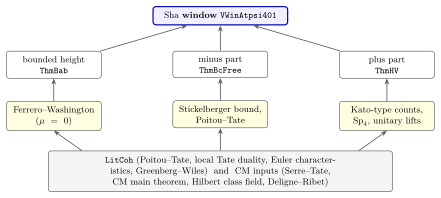
OpenImageCondition; none is assumed.| Input | Rests on |
|---|---|
bounded-height part
(ThmBab) |
thmBab_of_lemmaK with
ferreroWashington |
minus part (ThmBcFree) |
a Stickelberger-type bound \(\operatorname{len}\text{Ш}^-\log\ell\le
C\ell[E:\mathbb{Q}]^2(e+1)\log(e\ell N)^2\), via
ML.iv (Poitou–Tate and unramified orthogonality) |
plus part (ThmHV) |
counts I, II, III, V, Z and
LemmaK: Kato-type bounds, \(\mathrm{Sp}_4\) inputs, unitary lifts |
duality (LitCoh) |
Poitou–Tate, local Tate duality, local and global Euler characteristics, local and global finiteness, Greenberg–Wiles |
CM inputs
(LiteratureCMHypothesis) |
Grothendieck deformation, de Rham comparison, Serre–Tate, CM main theorem, Hilbert class field via \(j\), Siegel–Klingen and Deligne–Ribet, functional equation of partial zeta |
Theorem 36
(Ferrero–Washington [4). ,
UpperTheory.V.FW.ferreroWashington, Exact] For a
prime \(\ell\) and an abelian number
field \(K\) containing \(\mu_\ell\) (\(\mu_4\) if \(\ell=2\)) there is \(r\) such that every layer \(K'\) of the cyclotomic \(\mathbb{Z}_\ell\)-tower over \(K\) satisfies \(|\operatorname{Cl}(K')/\operatorname{Cl}(K')^\ell|\le\ell^r\).
Reading Bounded \(\ell\)-rank
up the tower is the statement \(\mu=0\) [16].
The proof occupies a 62-file folder
(GaloisLibrary/FerreroWashingtonIndex).
8.0.0.2 Provenance.
The literature structures are filled by Lean proofs
(..._from_literature, ..._of_open) from one
OpenImageCondition, which comes from Row0b.
That in turn is proved by the theorem
galoisLocalGlobalStrong_recParameter. The clean axiom check
means none is assumed.
8.0.0.3 Budget. Reading
The minus part is polynomial in \(t=x^{401}\), \([E:\mathbb{Q}]\approx x^{2+8\varepsilon}\) and logarithms; the plus part is at most \(\exp(x^{4\varepsilon/5})\) times a polynomial. Both are far below \(\sqrt b=\exp(x^\varepsilon/2)\), so the window does not touch the square root.
9 Why the \(2/3\) barrier does not appear
The outline (entry 14) says a calculation of the cost of each lift shows one would “stop at \(2/3\) a priori”. That calculation is not in the archive (Section 9.4). Here it is reconstructed from the code’s own quantities. Ours.
9.1 What the code charges
Verified \[\mathrm{charge}(j)=\sum_{\ell\text{
small}}\log\ell\sum_{\text{pieces at }j}\mathrm{colength}
\approx f\,m\,b\,x^\varepsilon=B_0,\qquad
E_b=\sum_{j=1}^m\mathrm{charge}(j)\approx m B_0.\] Each piece
belongs to one lift (NData.locs_mem), and each lift is
charged on its own block: the family is DefFam with \(L:J\to T\to\mathrm{BlockDat}\)
(RowLat.lean:213), and the exponents and lengths of lift
\(j\) are read from \(L(j,t)\) alone
(LiftLat.lean:147--151).
9.2 Accounting 1: compounding gives exactly \(2/3\)
If lift \(j\) were charged for the whole composite \(\Theta_j\circ\dots\circ\Theta_1\), then \[\mathrm{charge}'(j)=\sum_{j'\le j}\mathrm{charge}(j')\approx jB_0,\qquad E_b'=\sum_{j=1}^m jB_0\approx\frac{m^2}{2}B_0,\qquad \frac{E_b'}{n_Tmb}\approx m^2x^\varepsilon,\] and the balance becomes \(x/m+m^2\), minimised at \(m=x^{1/3}\), giving \(x^{2/3}\). This is the outline’s \(2/3\) exactly. The two facts above remove the extra factor of \(m\).
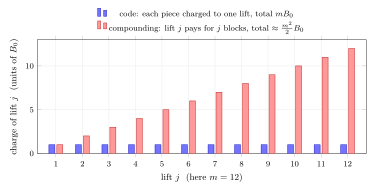
NData.locs_mem) and reads each lift’s
charge from its own block (DefFam.L); the compounding
accounting adds a factor of \(m\) and
gives the outline’s \(2/3\).9.3 Accounting 2: no gcd does not give \(2/3\)
Without the common lattice, the averaging over words in
Frame_at would be lost. Its only visible cost is \(\log\#W\le(k-3)\log2\approx
x^{9/2+10\varepsilon}\), negligible against \(n_Tmb\). So in this bookkeeping the gcd
does not save a factor of \(m\); its
role is to make one divisibility statement hold for all words.
9.4 No \(2/3\) route in the archive
Exact About twenty unused variants of the final growth bound exist, among them:
ChainAt,Chain6At,ChainAt7;FixedEpsilonGrowthBound;GrowthBracketBoundAtPoint;PowerBoundGivesRiemannHypothesis.
Every one concludes \(G(x)\le x^{1/2+O(\varepsilon)}\). No \(m^2B_0\) budget, no per-word or per-character dual lattice, and no balance with exponent \(2/3\) or \(1/3\) appears anywhere. The only “\(2/3\)” constants are factors like \((2/3)^f\) in volume bounds.
9.5 A planned test
We designed a perturbation experiment
(mechanism/PERTURB.md): loosen only the upper bound on
\(m\) in RankVal by \(x^{1/40}\), rebuild the roughly
13,000 dependent modules, and record which proofs fail. Our
prediction, written before running it: the failures appear in the window
lemmas (szRow_rankSizes, winA) and in the
\(m^5\) word-count lemma, not in the
arithmetic layers, because \(m\) and
\(k\) are locked with only about \(x^{0.26\varepsilon}\) of headroom. The
results will be posted as an update to this document.
10 The verification record
| Check | Result (20–21 November 2026) |
|---|---|
| Source scan | 0 sorry, admit,
axiom declarations, native_decide, reduceBool;
5 build-time code hits (informational) |
| Full build | 175,187 modules, 183,893 jobs, OK, 401 minutes on 94 cores |
| Statement | identical to Mathlib’s
RiemannHypothesis
(Mathlib.NumberTheory.LSeries.RiemannZeta) |
| Axioms | propext,
Quot.sound, Classical.choice only;
OVERALL: CLEAN |
| Olean comparison | 76,968 byte-identical to
Sutherland’s manifest, including Main.olean;
98,219 differ, every one embedding the absolute build path;
0 differ without a path. Recompiled at Sutherland’s build path, a random
sample of 300 of the 98,219 is byte-identical to the
manifest, 300 of 300 |
| Export hash | byte-identical match to the published
export: 61,570,595,788 bytes,
sha256 5ea74b91…244e (lean4export v4.33.0,
commit 15f6055e, 89 minutes) |
| Kernel replay | Main with imports trusted:
done; full –fresh replay not run by us (others report full
replays: Sutherland’s leanchecker, 175,187 of
175,187 modules; Simon DeDeo, likewise) |

Remark 37. The differing oleans store the source
path (for example /home/.../rh/lean/src/.../OrbitMult.lean,
once per file), which differs between machines. The kernel export holds
only declarations, and our re-export matches the published 61.6 GB
export byte for byte, confirming that the differences cannot touch the
proof.
Verified The path is the only difference. Sutherland’s build
passed sources to lean as
/home/ubuntu/grh/src/lean/src/<Module>.lean (his
comment in the community repository’s issue #6, where patunz first
reported the path dependence). We replayed, for a random sample of 300
of the 98,219 differing modules (seed 20261121), the exact
lean command that Lake recorded for each module in its
.trace file, changing only the output location and the
source prefix to his path. All 300 outputs are byte-identical to his
manifest. Before the sample, the same replay at our own path reproduced
our own .olean files exactly, so the replay is faithful to
the build (scripts/11_path_sample.sh).
11 Open questions, and what we could settle
Each question below is followed by what we could settle from the
source and the outline. Status: three answered within
the code (2, 3, 4), one narrowed (5), one still needs the author (1);
the call-level gap in step D4, the role of the constants and a static
reading of SizesAt are settled below.
Question 1. Is the compounding counterfactual of Section 9 the calculation behind the outline’s \(2/3\)?
Still open. The outline (entry 14, dated 15 November 2026) reports a “precise computation of the cost of each lift” and the figure \(2/3\), but does not show the calculation. Our reconstruction is the simplest accounting in the code’s own quantities that gives exactly \(2/3\); only the author can say whether it is his.
Question 2. Could a family with a smaller indefinite part per lift lower the \(m^2\) cost of \(E_b\), or does the Bloch–Kato count force it?
Answered within this chain. Verified
ShapeJumps k m t is required with the same \(m\) at every local piece, whatever lift the
piece belongs to (admG2,
EmbeddingTypes.lean:122), so every lift is charged rank
\(m\). Reading checked by
arithmetic: even a family whose rank tracked the shrinking indefinite
part, \(m-j\) at lift \(j\), would pay \(\sum_{j=1}^{m}(m-j)=m(m-1)/2\), still of
order \(m^2\). So no refinement of the
per-lift rank along this chain changes the exponent; it saves at most a
factor of \(2\). Lowering it would need
a rank of \(o(m)\) per lift, that is a
chain with a smaller indefinite part, hence fewer lifts, which costs on
the \(x/m\) side.
Question 3. Why must the lift exponent \(e'\) be as large as \(b=\exp(x^\varepsilon)\)? A polynomial \(e'\) would shrink \(B_0\), though not its dependence on \(m\).
Answered within this design. Verified \(e'\) is linear in a Hodge–Tate height
\(h_B\in[b,6b]\), and the heights are
of size \(b\) because the weights on
thick places lie in \([b,b+\eta+1]\).
Exact The weight scale cannot be polynomial: the \(\text{Ш}\)-window losses are themselves
exponential. The bounded-height condition is stated with \(\exp(x^{4\varepsilon/5})\)
(BaAt) and the plus part with \((\mathrm{cond}\cdot
t)^C+C\exp(x^{4\varepsilon/5})\) (HVAt), both to be
absorbed by \(\sqrt
b=\exp(x^\varepsilon/2)\). Reading So \(b\) is exponential to swallow those losses,
\(e'\approx b\) follows, and since
\(b\) cancels in the balance this sets
the absolute size of \(E_b\) but not
the exponent \(1/2\).
Question 4. Do the formal versions of Ferrero–Washington, Poitou–Tate, the Kato-type bounds and the CM inputs match the published theorems at full strength?
Answered: statements read for all four.
Ferrero–Washington. Exact The statement bounds \(|\operatorname{Cl}(K')/\operatorname{Cl}(K')^\ell|\) by \(\ell^r\) for every layer \(K'=K(\mu_{\ell^n})\) over an abelian \(K\supseteq\mu_\ell\) (\(\mu_4\) if \(\ell=2\)), with Mathlib’s class group. Reading \(\operatorname{Cl}/\operatorname{Cl}^\ell\) is elementary abelian of order \(\ell^{\operatorname{rk}_\ell}\), so this is bounded \(\ell\)-rank up the cyclotomic \(\mathbb{Z}_\ell\)-tower, which is equivalent to \(\mu=0\): the published theorem, in the form for \(K\) containing \(\mu_\ell\).
Poitou–Tate. Exact
PoitouTateNormalised: for a number field \(F\), a prime \(\ell\) with \(\ell\neq2\) or \(F\) totally complex, a finite set \(S\) containing the places above \(\ell\), and every finite \(\mathbb{Z}/\ell^r\)-module with a continuous \(G_S\)-action: normalised local invariant maps, the nine-term exact sequence, \(\text{Ш}\)-duality, and \(H^n=0\) for \(n\ge3\). Reading This is the standard theorem; the condition on \(\ell\) is exactly the case where the real places contribute nothing in degree \(\ge3\). It is proved unconditionally bypoitouTateNormalised_holds; the literature wrapper ignores its argument.Kato-type input. Exact
KatoTwoW: for an odd prime \(\ell\), an imaginary quadratic \(K\) with \(\ell\nmid \mathrm{disc}(K)\,h_K\), and a two-dimensional \(\ell\)-adic representation \(W\) with determinant the quadratic character \(\theta\) of \(K\), ordinary at \(\ell\), residually Eisenstein (trace \(\equiv\theta\cdot\chi^e\psi+(\chi^e\psi)^{-1}\)), irreducible over the cyclotomic extension of \(K\) and attached to a newform of weight \(2e+1\): the Bloch–Kato Selmer groups of \(W\) and of \(W\otimes\theta\) vanish. Reading As David Loeffler pointed out on Zulip (21 November 2026), this matches Kato’s theorem [8] directly without needing an explicit \(L\)-value hypothesis: in this setting the relevant critical \(L\)-value sits at \(s = 1\) in the analytic normalisation (to the right of the central point \(s = 1/2\)), where non-vanishing is automatic. It is proved in Lean (katoTwoW_of_printsH_of_rT_of_quadBC2).CM inputs. Exact Read statement by statement: Shimura’s main theorem of complex multiplication for imaginary quadratic \(K\) (
EllipticMainTheoremCM); \(K(j(\mathcal{O}_K))\) is the Hilbert class field, of degree \(h_K\), with \(j(\mathfrak a)=j(\mathfrak b)\) iff \(\mathfrak a,\mathfrak b\) are in the same class (HilbertClassFieldJ); Siegel–Klingen and Deligne–Ribet; the functional equation of partial zeta functions of totally real fields and of Hecke characters of CM fields; Grothendieck–Messing deformation theory over nilpotent divided powers; de Rham cohomology of abelian schemes (free, Hodge filtration, base change, rigidity, duality); the period relation and Gauss–Manin periods; and Serre–Tate (Néron–Ogg–Shafarevich, potential good reduction, good reduction of CM abelian varieties). Reading Each matches the standard theorem of that name in shape and hypotheses. We did not check the internal definitions they rely on (for example the global Artin map) line by line.
Since every one of these is proved in Lean and the axiom check is clean, Question 4 is about exposition: whether the names are honest descriptions. For the ones we read they are, with the caveat on the Kato-type statement above.
11.0.0.1 Comparison with Jaswal’s guide.
Manvir Jaswal’s reader’s guide [6] compares every classical input on the chain with its archive form (his Table 2) and reaches the same verdicts on Ferrero–Washington and Poitou–Tate. It adds two inputs we did not read, which it classes as weaker than the published theorems their names recall, both proved in the archive.
Galois representations (
Row0b, proved bygaloisLocalGlobalStrong_recParameter): local–global compatibility is asserted only when the local parameter is abelian or tame with zero monodromy, and at \(w\mid\ell\) only under extra data.Local parameters (
RecTExists): the map exhibited byrecTExistssatisfies the required laws but sends every supercuspidal outside a classGoodCuspto an unramified twist of one fixed parameter \(J_{w,n}\) (cuspEx,JunkEx), so it is not the local Langlands correspondence. The full correspondence is stated asLocalLanglandsGLand proved only conditionally.
Verified by name against the export of Main:
Row0b, galoisLocalGlobalStrong_recParameter,
RecTExists, recTExists, GoodCusp,
cuspEx and JunkEx are used;
LocalLanglandsGL is not. So the proof does not depend on
the local Langlands correspondence. Jaswal also classes the Kato-type
input as “Different” in shape, since it is stated with its own
hypotheses (Used, a newform attachment,
WitAQ), which is compatible with the reading above. His
Table 1 lists the statements on the chain for which he knows no
reference; several of them (ch_balance,
TheoremSSelected, LinkN, lemmaK)
are the steps we trace in Sections 4–8.
Question 5. Is the windowed Landau theorem (Theorem 5) new as a stated result?
Narrowed. Deducing zero-free regions from one-sided or localised information on prime sums is a classical line going back to Landau [9] and developed by Pintz (see the recent survey [7]), and effective versions of Landau’s theorem already give quantitative lower bounds for averages over ranges \([1,Y]\). The windowed statement is therefore close to known methods in substance; whether this exact form appears in the literature is for specialists to say.
11.0.0.2 The call-level gap in step D4 is closed.
Exact extendedClosedForm is the field
p15 of local_flatness_results, which feeds
loc8All_of, first_theorem_threshold_functions
and first_theorem_closed_form; the family bound from it is
Adm8F, a hypothesis of
admissible_family_no_kernel, whose output is what the gain
statement (AuxBlock8.Conclusion1, via
starAll_of) is proved from. So the \(\sqrt p\) lemma reaches the gain inequality
through the first closed-form theorem. Not checked: which lines of the
gain proof consume p15 specifically.
11.0.0.3 The constants do not matter for the theorem.
Exact ChebyshevInequalityAtWindowScale asks for
some constants \(e_D,e_L\) and
\(\varepsilon_1>0\) such that for
every \(\varepsilon<\varepsilon_1\)
there is a family with \(G_m(x)\le
x^{1/2+(e_D+e_L+7)\varepsilon}\) on its windows. Since \(e_D,e_L\) are fixed while \(\varepsilon\to0\), the Landau step gives
zero-freeness for every \(\operatorname{Re}s>1/2\) whatever their
values. Explicit constants would only matter for an effective
(numerical) version, which the development does not attempt.
11.0.0.4 SizesAt under
other exponents, read statically.
Exact Write \(m=x^\mu\), \(n=x^\nu\), \(k=x^\kappa\). In the abstract size layer
the exponents enter only through \[\tfrac12-\varepsilon\le\mu\le\tfrac12+\tfrac\varepsilon
2,\qquad
\kappa\ge1+\mu,\qquad \kappa\le 2\nu+\tfrac12-\varepsilon,\qquad
\kappa\le e_K\] (the bounds on \(\mu\) are in RestSize and
ErrWindows0), together with the family’s word count \(\kappa\ge5\mu+\nu\). Every other window
(CostWindows, GrowthInequalitySizes, the
bounds on \(L\), \(L_a\), \(b'\)) compares polynomials in \(x\) with \(b=\exp(x^\varepsilon)\) and holds for any
fixed exponents. So statically, \(\mu\)
is pinned only by the two windows that encode the balance, exactly as
predicted. What reading cannot rule out is a hidden dependence elsewhere
in the 13,000 modules downstream of the size choices; the
perturbation run (Section 9) will check that mechanically.
11.0.0.5 Still not traced.
The Lean proofs of the classical inputs of Section 8, as opposed to their statements; numerical values of the constants; the perturbation run.
Acknowledgements
The formal proof is Levent Alpöge’s. This account builds on public work by others on 20 and 21 November 2026, and overlaps with some of it:
Jonas Whidden’s Zulip readings (the balance, the frame lemma, the common-lattice question);
Bartosz Naskręcki’s proof guide and book [12], which also state the \(x/m+m\) balance, the localized Landau step, the choice of auxiliary primes and the Ferrero–Washington and Poitou–Tate premises;
JoseClaudioSJr’s reader’s map (community issue #5), which independently traces the windowed Landau route and the gain chain through
AuxBlock8.Conclusion1andstarAll_of;Andrew Sutherland’s verification record and build manifest [15]; the full kernel replays and independent rebuilds reported by Simon DeDeo and Elliot Arledge;
the dependency and dead-code analyses of James Shore (
james-shore/rh-proof-dependencies, 256,620 of 1,061,531 declarations unused), Sonoda, Drew Carlson and Keith Adler (rh-trim); patunz’s report on path-dependent olean hashes;the expositions of Yao Xu (
cadamcat/riemann-hypothesis-exposition) and jae-63 (rh-alpoge-blueprint), and the declaration index atriemann.tamnd.com.
Errors of interpretation are ours.
11.0.0.6 Use of AI tools.
Claude (Anthropic) was used to help read the Lean source, run searches over the declaration list, and draft parts of this text and its figures. Statements marked Exact or Verified were checked against the Lean source or the build outputs in the accompanying repository, and the references against their published sources. The author has read the whole text and takes full responsibility for its content.
References
[1] L. Alpöge, note accompanying the Lean development, 20 November 2026, https://alpo.ge/remark.pdf.
[2] S. Bloch and K. Kato, \(L\)-functions and Tamagawa numbers of motives, in: The Grothendieck Festschrift, Vol. I, Progr. Math. 86, Birkhäuser, 1990, 333–400.
[3] S. Chowla and A. Selberg, On Epstein’s zeta-function, J. reine angew. Math. 227 (1967), 86–110.
[4] B. Ferrero and L. C. Washington, The Iwasawa invariant \(\mu_p\) vanishes for abelian number fields, Ann. of Math. (2) 109 (1979), 377–395.
[5] H. Iwaniec and E. Kowalski, Analytic Number Theory, AMS Colloquium Publications 53, American Mathematical Society, 2004.
[6] M. Jaswal, The Riemann hypothesis for Dirichlet \(L\)-functions [after Levent Alpöge], preprint, 21 November 2026, https://doi.org/10.5281/zenodo.24410057.
[7] D. R. Johnston and T. Trudgian, A round of Pintz to celebrate oscillations in sums, arXiv:2511.09978.
[8] K. Kato, \(p\)-adic Hodge theory and values of zeta functions of modular forms, Astérisque 295 (2004), 117–290.
[9] E. Landau, Handbuch der Lehre von der Verteilung der Primzahlen, Teubner, Leipzig, 1909.
[10] L. de Moura and S. Ullrich, The Lean 4 theorem prover and programming language, in: Automated Deduction (CADE-28), LNCS 12699, Springer, 2021, 625–635.
[11] The mathlib Community, The Lean mathematical library, in: Proceedings of the 9th ACM SIGPLAN International Conference on Certified Programs and Proofs (CPP 2020), 367–381.
[12] B. Naskręcki, riemann-rev
(status dashboard, proof guide and book), https://github.com/nasqret/riemann-rev, November
2026.
[13] J. Neukirch, A. Schmidt and K. Wingberg, Cohomology of Number Fields, 2nd ed., Grundlehren der mathematischen Wissenschaften 323, Springer, 2008.
[14] G. Shimura, Introduction to the Arithmetic Theory of Automorphic Functions, Princeton University Press, 1971.
[15] A. V. Sutherland, build and verification page for the Lean development, https://math.mit.edu/~drew/grh/, November 2026.
[16] L. C. Washington, Introduction to Cyclotomic Fields, 2nd ed., Graduate Texts in Mathematics 83, Springer, 1997.
12 Map from steps to Lean declarations
| Step | TRACE.md | Key declarations |
|---|---|---|
| A. Windowed Landau | 1, 25.1 | zeroFree_of_rpow_window,
lemmaL, landau_window, poleData,
core_gm, rh_of_every |
| B. Isolation | 23 | ch_balance,
ThickPartTranslateMean,
GrowthInequalityExplicit, signal_term,
QH.pairEx, zero_density_box,
hostThickExists |
| C. Size bound | 2, 5, 12 | proposition_size_bound,
SZ.T1–T4, RankVal,
exists_ranks_rankVal_frame,
m_pow_five_mul_f_mul_L_le |
| D. Pointwise bound | 6, 7, 14 | each_unit_bound_statement,
Ga_bound5, ChainTied, linkCore,
linkGLOBAL7_items |
| D. Energy | 8, 9, 15 | SizeData_2.EDef,
NormDecompositionCond, factEtaMean,
nuAbs_place_fine, ClaimHigh |
| D. DIV | 10, 11, 16 | Data.DIV,
height_chain_atR, errB_of_units,
divisor_inequality_assembly,
error_absorption |
| D. Rank \(E_b\) | 13, 18 | rank_le_row,
ShapeJumps, NData.locs_mem,
linkN_of_gd |
| D. Common lattice | 17 | prescribedRowLat,
exists_divStage_of_pk, FamP.rrDef |
| D. Degree identity | 20 | NprimeMuR,
LinkG_at, LinkDIV_at, Frame_at,
loss_bound_at |
| D. Local divisibility | 21, 25.2 | key_minor_dvd,
key3Ord, link_of_local_closed,
starAll_of, gain_bound_all_of_star |
| E. Orthogonality | 22 | LinkS_at,
theoremS_link_concrete, matKF_of,
chosenProviso_min |
| F. \(\text{Ш}\) window | 24, 25.3 | VWinAt,
vwinAt_of_joint, of_four_alt,
ferreroWashington, ML.iv |
| \(2/3\) barrier | 15, 18, 19 | NData.locs_mem,
DefFam, Frame_at |